Greatest Learning Comes From Those Least Like Us

When Danny Graham was a defence lawyer he discovered, to his surprise, he really liked his clients. Everybody has a story to tell. If you can hear the story, you can learn and, in fact, you can bridge difference.

The awareness that those who are least like us have the most to teach us was heightened when his first child was born – imperfectly perfect with Downs Syndrome – as Danny had to adjust and readjust his expectations of parenting, his expectations of what his child would be like.

Danny Graham

Danny Graham

As he moved into restorative justice work – sparked by the discovery that he liked his defence clients, the understanding dawned that there were things only people at polar opposites – like a perpetrator and a victim –  could give each other. It was in the sharing of stories (worldviews or perspectives) that closure happened for many, that they could move on, that they could heal.

Different from me, different from you, does not mean less than. It just means different. In this Tedx Talk, Danny offers personal stories of parenting, restorative justice and politics – sharing his vulnerability, passion and worldview.

Danny and I became friends in 2005 as he was leaving politics. We each dedicated a significant amount of time to Envision Halifax over a four year period, inspired by its mission to ignite a culture of civic engagement, a mission still alive in what is now Engage Nova Scotia. In our conversations about this and other work, it is easy to see the alignment with the focus of Worldview Intelligence which creates the conditions and opportunities for learning from and with those least like us.

Danny Graham

Over a twenty year period, Danny Graham has held senior positions in business, law, government and politics. He is currently a Special Advisor to McInnes Cooper on business matters and the firm’s Corporate Social Responsibility Program. Since its inception in 2009, Danny has been instrumental in developing the CSR Program that includes environmental stewardship, community engagement, volunteer support and a pro bono program.

He is an experienced litigator, having been lead counsel in cases at all levels of court, including before the Supreme Court of Canada. He was Vice President of the Canadian Bar Association in Nova Scotia, and was on the National Executive of the CBA Criminal Justice Section.

Danny has been a senior advisor on justice matters to Justice Canada and the United Nations Development Programme, as well as a consultant to the governments of Thailand, Jamaica and Ukraine. He is also on the Board of Governors at St. Francis Xavier University.

In Nova Scotia, he is working with businesses, communities and government agencies on a variety of strategic matters – ranging from corporate social responsibility, to citizen engagement, to aboriginal rights and innovative leadership. He is currently Nova Scotia’s Chief Negotiator in the Made in Nova Scotia Process – the comprehensive rights reconciliation process amongst the Mi’kmaq, the Province and Canada.

Danny was the leader of the Nova Scotia Liberal Party and the MLA for Halifax Citadel in the Nova Scotia Legislature. He was the founding chair of the Nova Scotia Restorative Justice Program and Envision Halifax, and has been recognized by various organizations and news publications for his public and community leadership.

He currently leads Engage Nova Scotia, a grassroots citizen led initiative that is inviting Nova Scotia communities, businesses and institutions into discussions and actions about how to shape a new future for our province and is a member of the One Nova Scotia coalition.

Worldview Intelligence as a Workforce Strategy

workforce engagementIn the 2014 Deloitte Global Human Capital Trends research, 78% of business leaders rate employee retention and engagement as urgent or important and related research shows that most companies have low engagement and few strategies to achieve higher levels. According to Gallup, only 13 percent of the global workforce is “highly engaged” so there is a lot of room for improvement.

In an era of heightened corporate transparency, greater workforce mobility, and severe skills shortages, culture, engagement, and retention have emerged as top issues for business leaders. Yet, much of the formation and perpetuation of organizational culture is unconscious and engagement skills are lacking. At the same time, there is a growing hunger for in today’s workforce for connectedness and belonging in the workplace and beyond.

Worldview Intelligence is emerging as a unique way to make corporate culture visible and to identify intervention points that will enable employers to grow engagement and increase connectedness and belonging for those in their workplaces. When people feel connected to the work they are doing and the people they work with and for, they are far more likely to bring their passion and inspired selves to the workforce, upping workplace morale, productivity and effectiveness.

Love my job

A workforce that is Worldview Intelligent has the skills and capacities to foster learning, creativity and flexibility, to bridge differences and provide more opportunities for individual and organizational growth. It also has the ability to adjust rapidly and successfully to societal or environmental changes that impact its workforce, products, suppliers or customers. It benefits from a diversity of perspectives accessing greater creativity, innovation and problem solving. In many workforces, voices and perspectives that are different than the dominant views are often silent. While those voices and perspectives remain silent, gaps and missed opportunities abound. Learning how to invite those voices and perspectives in a genuine, authentic way is a skill that can be developed and nurtured.

Worldview offers a way to be in an exploration that is generative, healthy and adaptive. Part of the way it does this is by embracing difference as a key workforce strategy, giving voice and visibility to a multiplicity of views, perspectives and life experiences through a structured inquiry that illuminates components of individual and organizational worldview. It offers a language that does not assign value or point blame or judgment in any direction but invites curiosity, compassion and reflection.

Worldview Intelligence is a leadership skill for the 21st Century. Are you ready?

Transformative Questions Can Shift Worldview

 “The success of the intervention is dependent upon the inner condition of the intervener.” William O’Brien (deceased), former CEO of Hanover Insurance

QuestionsQuestions. When we adopt inquiry as a core part of a way of being in the world there are always questions. Some are simple: “How are you today?” Some are reflective: “Why did I say that? How can I help in this situation?” Some challenge us to explore areas of interest more deeply: “What is the theory behind…? How can we be intentional about collective transformation?” Some are at the core of our worldviews: “What is really real? Who am I? Why am I here?”  And sometimes a question can change our lives by creating the conditions to alter our worldview. The asking of a simple question can be a transformative experience.

Jerry Nagel Floor Teach ed

July 3rd, 2003 I experienced the transformative question that started me on a journey that would shift my worldview, although I didn’t know it at the time. I was part of a small group of people working on agriculture and rural policy issues in the United States that had traveled to Europe to examine how environmental and social values were impacting European agriculture practices.  During dinner one evening a powerful question emerged within the group that influenced our conversations for the rest of the trip.  The question was “Have we been asking the same questions [about rural development policies] over and over for so long that we don’t even know what the right question is anymore?”

This transformative moment started me on a journey of exploration, learning and self-reflexivity that has led to a shift in my worldview, a change in professional focus and a reconnecting with a curiosity about human behavior that I had explored in my early teens. It also reconnected me to a strongly held belief in human possibility that developed in my late teens and twenties and a deeper awareness of our connections to something greater that, for me, is sensed most during my times in nature.

in nature

As I explored ideas, methods and programs to find the right questions for addressing the current rural policy issues in my work back home in Minnesota in a change lab initiative called the Meadowlark Project and through my participation in the Donella Meadows Leadership Program, I couldn’t escape a similar question that was simmering within me, “What was my own personal ‘right’ question?” Having spent my professional and intellectual life working as a research economist on rural development with a worldview that assumed that if we created investments in the material well-being of people and communities (jobs, buildings, roads, etc.) then rural communities would thrive, it surprised me to discover that when I challenged my professional worldview I was also challenging my own personal worldviews and related sense of self or identity as an economist.

There were two big learnings from my work with the Meadowlark Project Change Lab. First was a recognition that while we all wanted to have the difficult conversations about the challenging and complex issues the Change Lab was working to address, we didn’t have the skills to have them. Second was a realization that while addressing the material well-being of a community was important and necessary, it was not sufficient to build a wholly healthy community. To do so both the material and human side of a community’s life needs to be addressed.

I found myself drawn more and more to actions that connected the work of rural development with one’s own or a community’s set of values and beliefs, which also connected with the work of my own personal explorations.

“The essence of our leadership journey is about growing into our true identity as a leader and, by doing so, accessing an intelligence that is greater than ourselves and encompasses the whole.” – Petra Kuenkel, Mind and Heart, 2008

As someone trained in economics, my worldview was deeply embedded in the notion of ‘man’ as an independent actor making rational choices of pure self-interest. I found myself challenged by the paradox that we humans experience ourselves as separate, unique and free individuals, and the social constructionist perspective, which I was learning about and coming to accept while writing my doctoral thesis on worldview and Art of Hosting, that everything that we are and all that matters actually comes from our relational experiences as humans and that this begins the moment we are born (and possibly before).

These paradoxes troubled me for some time, as I also sensed that exploring them was part of the journey to connecting with my life journey. So, while keeping one foot solidly planted in the work of answering the emergent questions about rural development policy I also committed to an even more intentional self leadership exploration of the deeper questions of “Who am I? What is my nature?”

The challenge it seemed to me in this exploration was to let go of attachments to specific images of myself that would prevent me from not only participating in whatever evolutionary changes this journey might offer, but also prevent me from seeing the whole and my relatedness to it. I was beginning to understand that my journey was becoming an exploration of the ‘range’ of me rather than the ‘one’ of me.

The work my colleagues and I have taken on through the Art of Hosting Conversations that Matter invites us into a wholeness – a way to connect how we are in the world with practices that support our actions. It also invites us to continually be aware of our worldview(s) and the impact on our leadership and hosting.  For me, as an AoH practitioner and host, this is an essential element in the exploration of growing my leadership and my hosting artistry.

Surprising Polarization of Dress Colour Debate

WControversial Dress Colourho would have thought the colour of a dress would provide fodder for a polarizing debate between friends, family members, colleagues and even complete strangers; yet that is exactly what has played itself out on social media this week.

There is a science behind the colour perception, as described in an article in Wired Magazine, but what is more fascinating is how attached people became to their perspective, their need to have other people validate what they were seeing, to defend themselves along with the tendency to dismiss, pretty vehemently at times, the people who saw the colours differently. As if there was only one way to see it, as if everyone must see it the same way, as if, if you didn’t see it that way, there was something wrong with you or your eyesight. Dismissing out of hand the possibility that each person who viewed the picture, no matter what they saw, no matter if they saw it differently, might also be right. Many “rights”, no “wrongs”. The opportunity for a mutual exploration and expanded view was often not even on the radar of this social media frenzy.

There were surprisingly few who brought curiosity and inquiry to the discovery that different people saw different things. Yet, this is the reality of how we function in the world. Each of us has a worldview. It impacts how we see and interact with the world, events, situations and other people.  Our Worldviews influence our communication, decision-making, family dynamics and workplace cultures and most of this happens unconsciously.

Most of us have never stopped to think about what our worldview is, where it comes from, how it influences us or why it might be helpful to be aware of worldviews – that we each have one, what our own worldview is, what the worldview of others might be.

See how fast this dress colour debate exploded, hitting the radar of so many with so many different reactions: some people engaging in it fully, some people seeing the debate as foolish and a waste of time and some just standing on the edges looking in, observing but refraining from comment. Does this little scenario sound familiar? It is one that is acted out over and over again in the human dynamics of our experiences at work, in community and at home. Think of some small issue that seems completely blown out of proportion to the point it challenges relationships and even gets in the way of making progress. Some might be attached to their point of view. Some might find it hard to see the situation from someone else’s perspective or to invite and hear someone else’s story of their experience if it contradicts their own.

Maybe we only experience it as hard or challenging because we don’t have the language or a structured approach to begin such a conversation and to stay with it. Maybe if we could understand that the way we see the world, the way someone else sees the world does not make any of us right or wrong. And in a mutual exploration, how we all see the situation, the issue or the event, might expand. Maybe we would find ourselves more willing and able to bring compassion to the whole situation, ourselves and others to fuel a generative space where we can all learn, do and be more.

Worldview Intelligence provides a simple, elegant, structured approach to exploring individual and collective assumptions, beliefs and value systems with curiosity, compassion and non-judgment. It is a both an individual and an organizational exploration. It opens the potential for more comprehensive approaches and solutions to emerge on a range of issues and opportunities, including those that might be mildly oppositional to completely divisive to seemingly unsolvable. Maybe those little and large issues you and your team are grappling with at work could use a good dose of worldview exploration and the opportunity for new narratives to emerge.

(Thanks to Marc Lewis of 3 O’Clock for suggesting the post.)

Worldview European Connections – European Commission and Leo Apostel Center

“What if there was a new way into, and through, our most challenging conversations? What if there was a simple guide to learning how?”

These were the calling questions for the half-day Worldview Intelligence offering at the European Commission (EC) in Brussels on February 24, 2015, attended by EC Art of Participatory Leadership (AoPL) Community of Practice members and by some who had just finished six weeks of ULab Hub Belgium.

Leadership and hosting experience in the room ranged from deeply skilled to relatively new and everything in between. People arrived with mild curiosity and left with a deeper curiosity and enthusiasm, steeped in reflection of and appreciation for what more is possible.

20150224_144832

In what is rapidly becoming a multi-faceted, multiple offering Worldview program and curriculum, Jerry Nagel and I shared with the group the most basic aspects of both the personal and organizational worldview explorations including:

  • The six dimensions of Worldview we have adapted from the Apostel framework for both personal and organizational explorations
  • The role of systems thinking in shaping worldviews and in identifying organizational intervention points, and
  • Our application of Theory U to this exploration.

20150224_145048

The conversation throughout the afternoon and in the check out circle was rich and affirming for the Worldview exploration we are in. Some reflections from the participants include:

  • This is a new capacity we need to be developing for our time and we are ready for it – this invites a search for common ground as a platform for searching for and recognizing diversity
  • This worldview exploration is a systemic approach that provides the structure and opportunity for reflection not so readily available in AoPL
  • We might be able to move some things that have been stuck by using this approach
  • This puts worldview in the middle, makes it explicit, invites people to become construct aware and is value neutral – it just lets it lie there in the center of our conversation and exploration
  • I appreciate the different elements that allow us to work with worldview, how we look at our own worldview – it is brought alive by the lived stories you share – you are living the content and sharing it fully
  • The individual and small group exercise helped me dive into the subject
  • This is a valuable approach to know and work with, misunderstanding of worldview leads to so much of today’s conflict – I want to learn more
  • From a Commission perspective, we are a totally multi-cultural environment and we need to grow our awareness of how to work with this consciously – this should be incorporated into advanced training
  • The European context is changing – 50 years ago it was based on peace on a large scale coming out of the war, but young people now have no connection to that – we need a new narrative
  • Appreciate the connection to Theory U and the ULab and seeing a new application and experience of Theory U

20150224_170337

Prior to the Worldview offering at the European Commission, we visited with people from the Center Leo Apostel for Interdisciplinary Studies at the Vrije Universiteit Brussel in Belgium. The Apostel framework is the one Jerry adopted for his PhD dissertation on Worldview, the Art of Hosting and Social Constructionist theory, that we are now adapting for the Worldview Intelligence curriculum. The Center was quite intrigued by our work, told us at the moment we are more actively working with worldviews than they are, noting that they are not aware of anyone else translating this into practical application.

This trip to Brussels enabled us to illuminate the weave of the evolution of this work from the origins in Europe through Apostel’s work, our practical offerings in North America to this first offering in Europe. The deep reflective space, the exploration of possibilities and the excitement and enthusiasm generated through this exploration is inspiring and fuels the ongoing evolution of this work.

Gratitude to Michaela Sieh for spontaneously inviting us to the EC CoP and ULab when she heard we were coming to Brussels and to Andrea Erdei for arranging the space for us to work in and sharing photos from the gathering. Also, to Michaela and to Ria Baeck, for helping co-evolve the calling questions and to our AoPL mates Helen Titchen-Beeth, Ursula Hillbrand and Ian Anderson for sharing in the experience and offering us beautiful insights into what more is possible.

Understanding Worldview and How It Impacts Us As Leaders and Hosts

Each of us has a worldview and a personal story about how we perceive reality. Our worldview combines the cultural and personal beliefs, assumptions, attitudes, values, and ideas we hold to form maps or models of reality. Our worldviews come from our collective experiences in society – from our parents and friends, the books we read and movies we watch, the music we listen to, our schools and churches. We then interpret these experiences into an individual worldview.

World view eye

In practice, we use our worldviews, without necessarily being conscious of it, to construct complex conceptual frameworks in order to organize our beliefs about who we are and about the world we live in. These maps or models help us explain how we view the world and why we act as we do in it.

Our experiences within the contexts we live in, be they religious, geographic, or cultural, all contribute to how we interpret reality.  Often this vision of reality is not fully articulated in our conscious awareness. In fact it could be so deeply internalized that we don’t question where it comes from. As leaders, practitioners and hosts of the Art of Hosting Conversations that Matter, organizational leaders responsible for creating inclusive workplaces and engaged teams, OD consultants responsible for change initiatives, continuous learning and restructuring and HR consultants (internal and external) responsible for leadership development and policies on diversity, equity and inclusion and social change agents inside and outside of organizations, this is first an invitation into personal inquiry.  Understanding our own worldview grows our capacity to host and work with others better.  Especially because our worldviews influence every aspect of our lives – what we think about, how we act, what assumptions we make about others, what motivates us, what we consider to be the good, the moral and the true. It gives coherence to our lives. It is the channel through which we interpret reality as we see it.

Worldviews are an individual phenomenon and a group, organizational, community and cultural phenomenon. Everything we hold to be true is found in community. A community is not just a geographic or placed-based clustering of people living together as a village, town, city or nation. A community can also be a discipline in science, a faith community, a community of practitioners of a type of music, art or sport or a community of practitioners of Worldview Intelligence; and these communities are part of a world of multiple simultaneously existing local realities. These local constructs or realities are primarily constructed through language based processes such as the written word, art, music, dance, speaking, symbols, sign, etc. Thus, it is through ‘language’ that we represent our worldviews and it might be through language that we will begin to understand another’s worldview.

Worldviews are not necessarily or always fixed. Individual and community/cultural worldviews often shift or change. These changes can be quite small and hardly noticed at first, but eventually have a transformative impact.

Worldviews can also change quite significantly as evidenced by many changes in the past century resulting from scientific advances (flight, Internet, space travel, atomic energy, etc.). Some shifts can be so transformative (or converting) that people change religions or physical characteristics. So, while worldviews are locally constructed, they can shift based upon changes in local or global constructs as well as individual or collective experiences. On a personal level, these types of changes often manifest in some form of spiritual experience that impacts a person’s view of self in the world (Schlitz, Vieten, & Amorok, 2007).  In effect, we have the ability to change our worldviews with awareness, consciousness and intentionality.

If our worldviews are mainly locally constructed, then we could ask, “What consequences do these local, cultural worldviews have for our ability to work together?”  One answer is that they can create barriers to understanding and finding common ground for working together. Which raises questions of “What to do about it?” and “How can we avoid collisions of worldviews and instead come together in ways that build understanding and respect and allow each of us to hold on to that which is most important?”

The invitation, individually and in our work, is to be in inquiry, to be curious; to be nonjudgmental; to approach our work from a stance of not knowing; to practice generosity; to value good conversations and recognize that good conversations can lead to wise action; to remember that the practice is the work and to remember that manyworld views can exist in the same place when we step out of either-or thinking into the welcoming of many different perspectives in the same space and time, celebrating difference rather than insisting on sameness. Growing our capacity to invite multiple worldviews on the individual and collective levels creates more invitational space for ourselves and for others to show up in the fullness of who we each and all are.

Some references related to this post:

Jenkins, O.B. (2006) Worldview Perspectiveshttp://orvillejenkins.com

Schlitz, M., Vieten, C., & Amorok, T. (2007) Living Deeply: The Art & Science of Transformation in Everyday Life. Oakland, CA: New Harbinger Publications.

Schlitz, M., Vieten, C., Miller, E., Homer, K., Peterson, K., & Erickson-Freeman, K. (2011) The Worldview Literacy Project: Exploring New capacities for the 21st Century Student. Institute of Noetic Sciences, Petaluma, California.

Hosking, D. M. (2011) Telling Tales of Relations: Appreciating Relational Constructionism, Utrecht School of Governance, Utrecht, Netherlands.

Worldview, Practice and Action – Taking Whole

In Art of Hosting trainings, several of my colleagues and I have been offering a teaching on worldviews and the importance for each of us to understand what our own worldview is. I often link it to elements in the Art of Hosting workbooks that I feel are an expression of an AoH worldview such as seeing the world as a complex living system and not a machine.

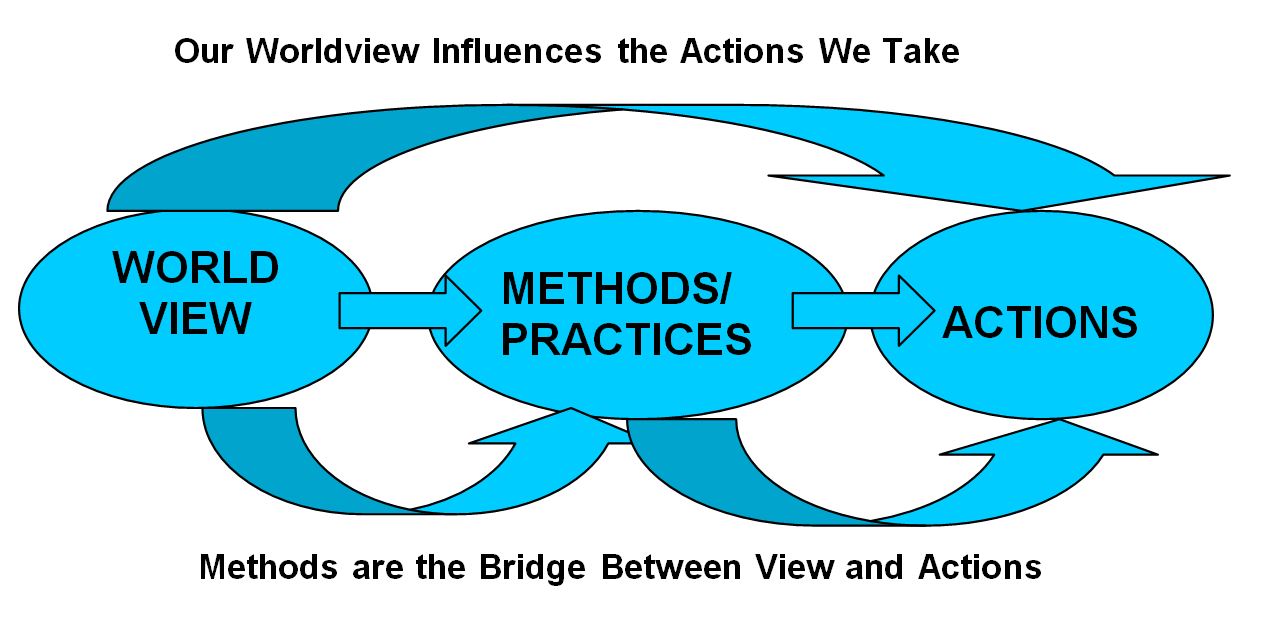
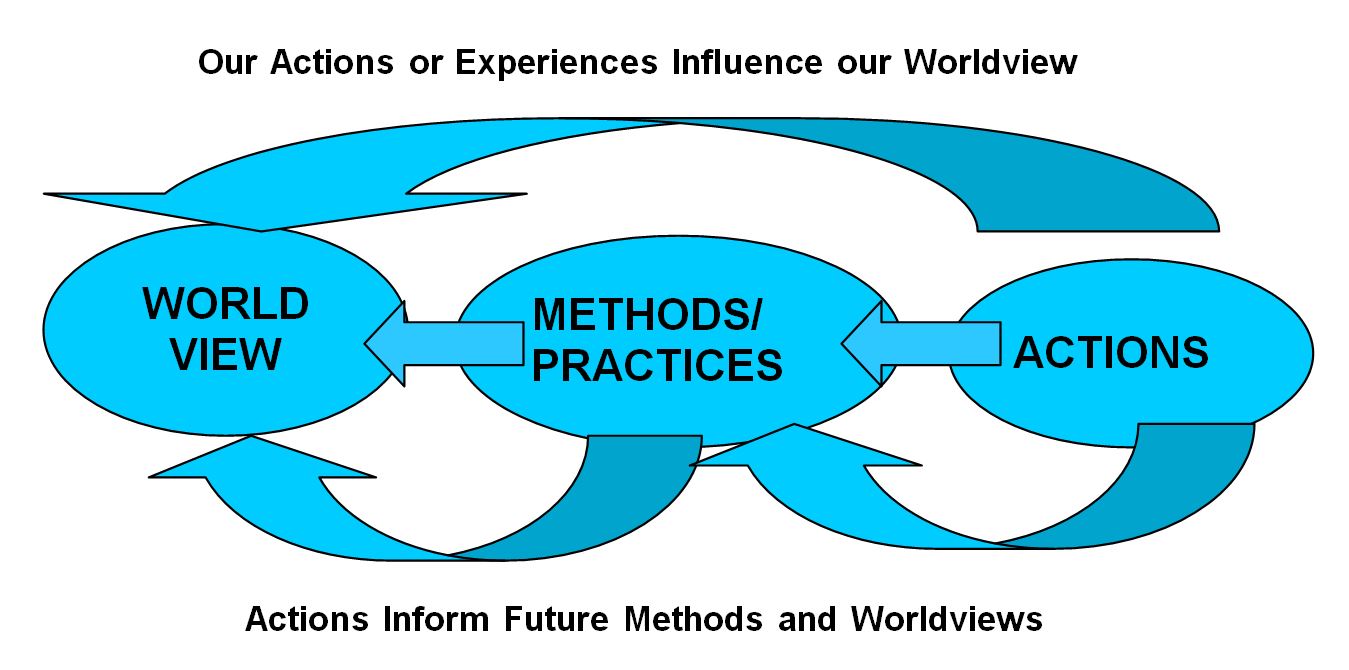
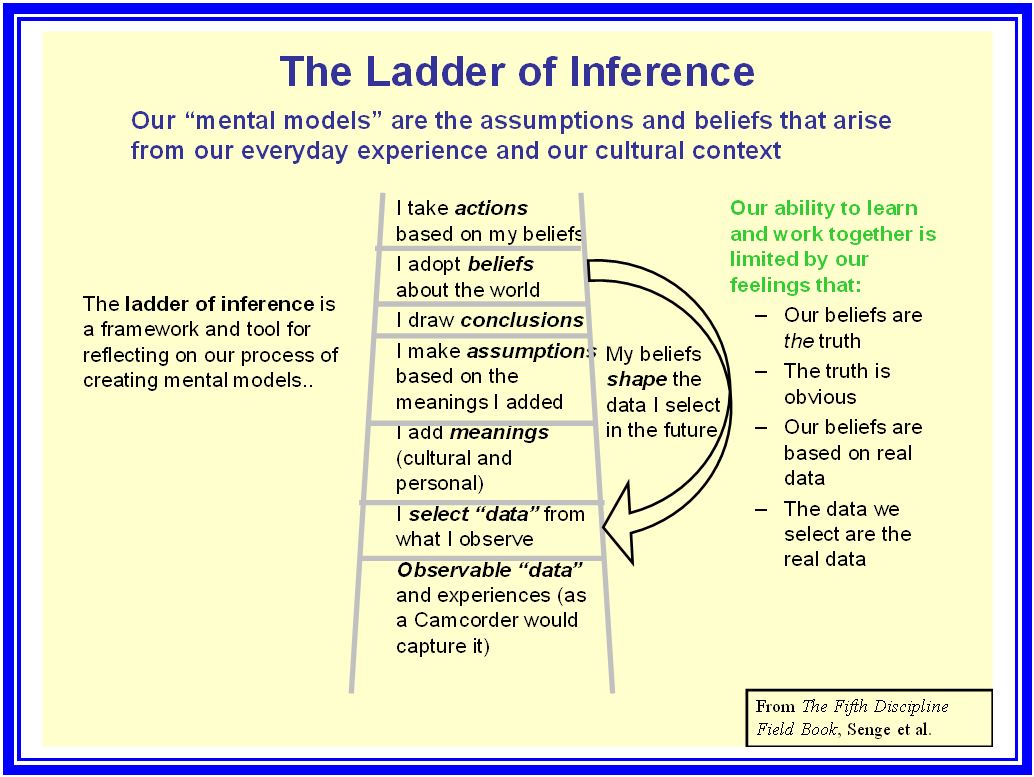
The simple teaching has two components – an explanation of worldview impact using the Ladder of Inference from systems thinking and an explanation of worldviews in The Rules of Victory: How to Transform Chaos and Conflict – Strategies from the “Art of War”. (Gimian & Boyce, 2008) The text known as the Sun Tzu and more popularly as The Art of War offers a framework for action that contains three components – View, Practice and Action. Central to view is the idea that the world is an interconnected whole. Seeing the world this way informs one’s Actions in the world and the Practices used to manifest (act) the View of interconnectedness. In the Sun Tzu this idea is referred to as ‘taking whole’.

The diagrams below show how our worldviews impact the actions we take in the world and, that as we act in the world, our worldviews are impacted and potentially changed; that patterns and practices like those offered by the Art of Hosting are the tools or methods we use to bring our worldviews to action; and that as we act in the world what we learn impacts the methods we choose to manifest our worldview. If the methods we choose to manifest our worldview are not congruent with that worldview, then our actions will not ring true with people. They will see us as not acting in a way that reflects the worldviews we claim to hold. This simple explanation has proved quite thought provoking for AoH participants.

Worldview Influences Action

Our Actions Influence our Worldview

A worldview can also limit us, because it could close us off to new knowledge if we only see the world through our existing knowledge and assumptions. (Jenkins, 1999) Importantly for many of us, our worldview offers us a way to understand the world that gives us “a feeling of being home” and that reassures us that our interpretations of reality are right. (Heibert, 1997)

Ladder of Influence

One tool from systems thinking that helps visualize how easy it is to get trapped in one (world) view and close off the possibility of seeing other perspectives is the Ladder of Inference. The process depicted follows a flow from the bottom of the ladder up to the top. We ‘see’ data in the world and go through a process of sense-making that then informs the actions we take. What the Ladder of Inference shows us is that the beliefs (worldviews) we adopt can influence what data we see. The result is that we begin “seeing only what we want to see.”

If we are in a time in the Western world of co-creating a new narrative of wholeness, then as hosts it becomes important for us to not only clearly know what our worldview is, but to understand that within our own contexts and within other contexts there could be greatly different worldviews. (Shire, 2009) In other words, given the depth of invitation to step into dialogue (discourse) that we are asking of people, we should remember that our worldview could be much different than someone else’s within our community or local cultural context. And, that people we are working with that are from other local contexts may have differing worldviews within that shared construct.

In thinking about our world today it is fair to say that, “The presence of a multitude of alternative worldviews is a defining characteristic of contemporary culture. Ours is, indeed, a multicultural, pluralistic age.” (Naugle, 2002) Thus, as we practice dialogue in our world in order to find ways forward, we must develop the capabilities to work in the multi-varied and rich system of many worldviews. To do so, however, requires skill and practice and the capacity to hold paradoxes or multiple truths all at the same time.

Learning to effectively communicate (host/facilitate) in a different or new cultural milieu is a deep-level process.  It involves connecting at more than an intellectual level with the ‘host’ culture. It involves connecting at a heart and spiritual level. If worldviews are a matter of the heart, then to enter into effective communications within a different or new culture means opening up one’s heart as a host/facilitator to a space/place that connects heart to heart. This involves capacities to be vulnerable, to respect difference, to be curious and to sit in the space of the unknown or unknowing (i.e. nonjudgment), and to be self reflexive regarding one’s own thoughts, reactions, and carried in thinking about another culture. It also involves recognizing the limiting role our language can play when hosting, which will help each of us as hosts to hold our own and invite others to hold their opinions about another’s worldview much more lightly. This is a core part of the artistry of hosting.

References

Hiebert, P. (1997) Conversion and Worldview Transformation. International Journal of Frontier Missions. 14(2)

Jenkins, O.B. (1999) Worldview Perspectiveshttp://orvillejenkins.com

Shire, J. (2009) The Universe Next Door: A Basic Worldview Catalog. Nottingham, UK: Inter-Varsity Press.

Naugle, D. (2002) Worldview: The History of the Concept. Cambridge, UK: Wm. B. Eerdmans Publishing Co.

A Way Forward When Worldviews Collide

In September 2011, Jerry Nagel was invited to do a TEDx talk on worldview – When Worldviews Collide. His understanding of worldview has evolved from his research for his PhD on Worldview, Art of Hosting and Social Constructionist theory and the practical experience in AoH trainings, other events and now specifically the rapidly evolving curriculum for Worldview Intelligence programs.

Take a look. Learn a bit about what happens when worldviews collide and what happens when we enter the space of curiosity instead.

Jerry Nagel

Jerry Nagel

What is it to be Worldview Intelligent?

Individuals, organizations and communities all have worldviews. They operate at least 80% unconsciously and impact how individuals, organizations and communities see and interact with the world, events, situations and other people or organizations. Worldviews influence relationships, communication, tension or conflict, decision-making and workplace cultures.

To be Worldview Intelligent means honing your skill and capacity – or that of your organization to invite and work with a multiplicity of worldviews. This rapidly evolving body of Worldview Intelligence™ work generates a deeper understanding of worldview, how worldviews are developed and why understanding them and growing the skill to work with them creates a fundamentally different environment for some of today’s most challenging conversations.

worldview camera lensTo be Worldview Aware is to feel, experience or notice that worldview(s)exist, individually, organizationally, in community and across stakeholder groups. It is knowing and understanding more about what is happening in the world, locally, regionally and globally, by being or becoming  aware of worldviews – first your own and then, with curiosity and compassion, someone else’s.

An individual,  organization and/or community that is worldview aware offers greater leadership potential and creativity that arises from the interaction of multiple worldviews, leading more often to innovative ideas or solutions and more diverse, welcoming, inclusive (work) places, more creative problem solving, planning and strategy development.

With some of our most entrenched issues and challenges in today’s world and the growing visibility of some of these issues (racism, discrimination, sexism, police violence as a few examples), Worldview Intelligence™ and becoming Worldview Aware may help us discover together pathways that do not currently exist. Letting go of what we know to discover what wants and needs to happen.

You can follow the conversation at our Linked In group and or our Facebook group.